Tokyo’s Everyday Robots and Technology in Daily Life of the Japanese people
Where to observe and interact with robotics and new technology in Japan
For curious travelers and technology professionals or those doing competitive research, Tokyo offers a glimpse into the future even in ordinary activities like shopping, commuting, eating out, and visiting galleries. Robots and innovative automated systems are present not to impress locals and visitors, but to address practical issues such as inclusive participation, accessibility, mobility, workers and customers convenience. While you take a walk into the city of Tokyo is interesting to not simply observe how advanced technology is, but witness how it becomes part of everyday life.
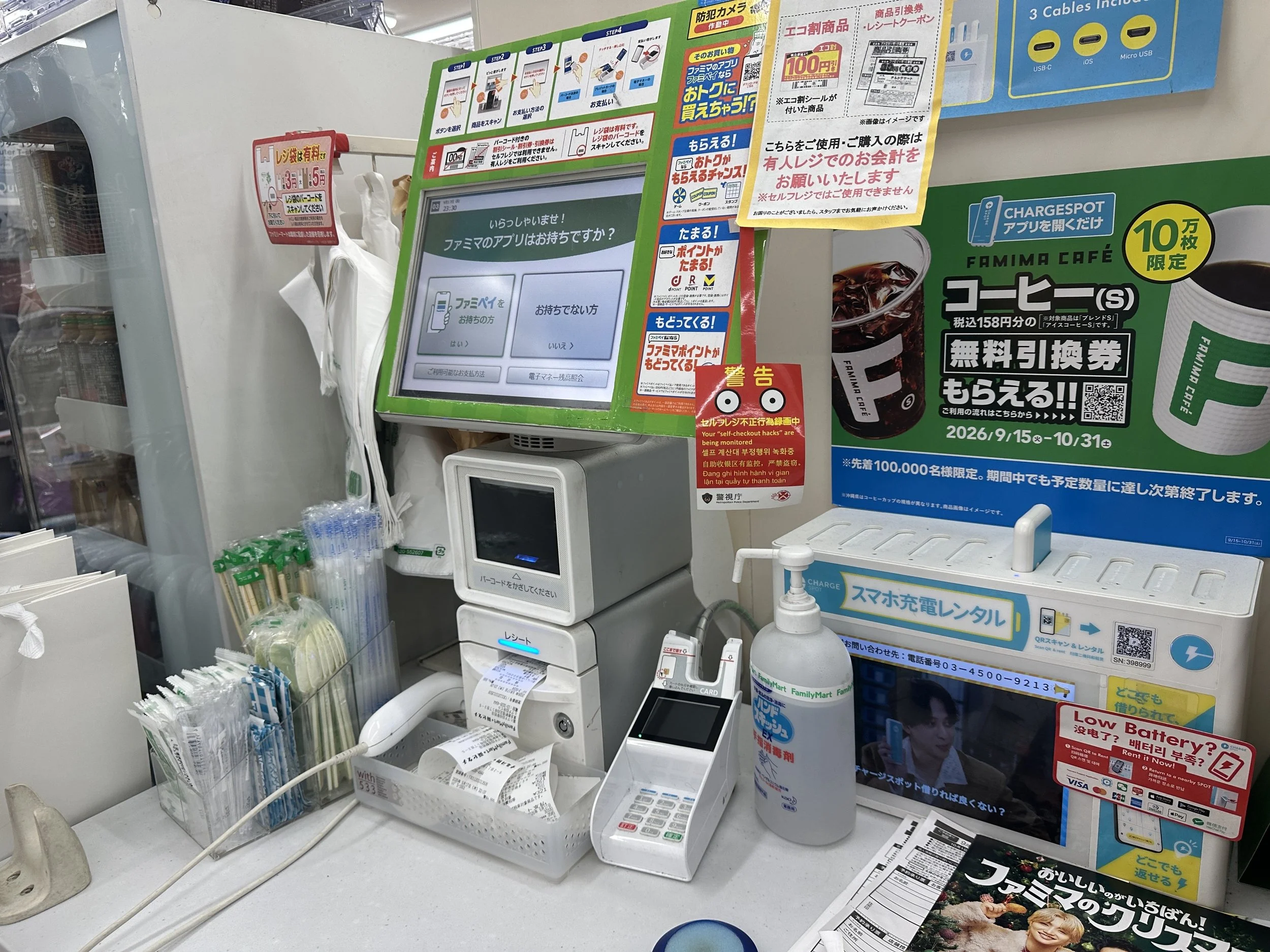
What is a futuristic shopping experience?
At selected FamilyMart stores, autonomous or semi-autonomous payment systems allow customers to purchase items without using a traditional human cashier. These systems are designed to improve efficiency while allowing staff to focus on other tasks, such as restocking shelves or assisting with products that require human support and contact.
A similar concept can be experienced at TOUCH TO GO in Takanawa Gateway Station or in UNIQLO stores. Cameras and AI identify the products customers pick up and allow them to pay through a touchscreen without scanning each item individually. The result is fast and seamless experience designed for speed and convenience
It is important to note accessibility challenges with such touchscreen systems.
What are new forms of mobility?
Takanawa Gateway also tests autonomous transportation. Small self-driving vehicles move passengers around at low speed, offering a peek of how future neighborhoods may combine pedestrians, public transport, and automated mobility.
When visiting the Odiba district of Tokyo, you will encounter vehicles that are powered through a hydrogen fuel-cell system. JR East describes this as part of a broader effort to develop environmentally friendly mobility and logistics.
The emergence of such machines interacting with and being tested in the public raises practical questions: How can they support movement without making cities more complicated?
Can robots enhance human connection?
At BUNSHIN Robot Café DAWN, a cafe in Nihombashi Tokyo, robots support human participation rather than replace it. People who may be unable to leave their homes or hospital rooms, including people with disabilitie, operate the café’s OriHime robots. Similarly, the company Herbalony also uses the same robots to allow customers to interact with the artist that is showcased in the store. Heralbony Laboratory Ginza is a great stop for visitors and professionals interested in social innovation, inclusive design, and Japan’s fashion Industry. The space is not only a store where customers can buy colorful products, but it also serves as an art gallery. Visitors can encounter artists’ original artwork alongside the fashion products developed by Heralbony’s collaboration with artists with disabilities. During a recent exhibition of Mika Kamijo, the Japanese artist who won a previous HERALBONY Art Prize, the gallery was equipped with an Orihime Avatar Robot that allowed visitors to engage and talk with the artists from her studio.
Through the robots, operators can welcome customers, provide services, and take part in work and social interaction usually inaccessible to them. It is an important example of inclusive technology. The robot cannot act independently and allow a person a presence in a space they cannot easily access. With robotic assistance, companies can rethink both work from home and the entire essence of what it means to be an employee.
Can Robots serve as emotional support?
LOVOT Café offers another perspective on robotics and technology that can be designed not only for efficiency, but also for comfort, companionship, and emotional support.
LOVOT robots are meant to be companions rather than service machines. They are warm to the touch, respond to people, recognize familiar faces, and behave in ways intended to create emotion based interactions. Visitors can interact with them while enjoying food and drinks. In lots of housing situations pets are not allowed so emotional support animals are not therapeutic methods that can be explored. LOVOT robots may be an alternative to these kinds of restrictions while serving a similar purpose. This is especially relevant as families are spread further apart due to globalization, increasing the incidence of loneliness worldwide.
Another group is using the traditional art of Japanese puppetry or Ningyo Joruri, an intangible folk cultural property, to study human emotion. The study helps to preserve this treasured Japanese artform, in a time when the population and knowledge of artisans is dwindling. Robotic movements and expressions closely resembling humans are helping to preserve culture.
Can Robots simplify and support a clean city?
In Shinjuku Station, JR East tests autonomous trash-can robots that move through the underground crowd. Passengers can place rubbish inside as the bins travel along programmed routes.
The robots make waste disposal easier to find and reduce the work involved in emptying bins. Their slow movement and ability to stop when people approach also challenge testing automation in one of Tokyo’s busiest environments.
Tokyo’s experiments suggest that the future may not be about replacing people entirely. It may be about creating new ways for people to work, move, shop, connect, and participate.
For travelers, these technologies offer more than a futuristic spectacle. For professionals, they provide a chance to observe how innovation is introduced in real environments—and how people respond when technology becomes part of ordinary daily life.
What can Robots do to support wellness and independence?
Robots developed in Japanese universities and by local businesses regularly make appearances at local events. Tokyo’s premier start-up and technology event, SusHi Tech, held annually in the Spring, featured a robot and culture pavilion. One such robots demonstrated how the experience of playing a musical instrument is often something that leaves people of various abilities out. Instead, a research laboratory developed a series of semi-automatic instruments that enable a hole new class if musicians.
Rehab and the road to wellness sometimes is scary and intimidating, but the approach that a clinic in Kanagawa, just outside of Tokyo uses integrates robots and games to make rehabilitation fun, such as a wii-powered sit ski training experience. The clinic resides in a Japan’s premier deregulated zone, Sagami Robot Industry Special zone, which has been destined to support public and private collaboration for medical, service, and personal care robotics.
The TokudAw Difference
Traditional travel agencies will bring you to destinations of your planning, arrange a package from a set group of vendors and partners while leaving you to adapt the lessons and learnings for your business. TokudAw is different. Every business service is tailored to the needs of your group. What are your objectives, what do you want to study, know, or do as a result of your time in Japan? Your objectives are ours. We’ve an agency built by working academics and professionals in STEAM. We understand what it takes to do business across the world and the importance of a great partner. Complete our contact form so that we can discuss how we can support your organization.
Disclosure: TokudAw is a SusHi Tech ambassador.
FAQ
Where can I experience interaction with robots in Tokyo?
TokudAw’s non-exhaustive list is a good starting point to discover daily robotics in Tokyo. Some experiences might be temporary trials, so it is important to confirm availability before visiting.
Are these robots controlled by AI?
Some are automated but some robots like the ones at DAWN café are controlled by human operators. If you want to experience interactions with these robots but cannot speak Japanese, TokudAw can guide you and provide you and your group with interpreters.
Are these technology experiences suitable for business or student groups?
With the right questions and informed observations, these experiences offer a starting point to exploring accessibility, service design, and mobility related innovations with technology outside a laboratory.
Can TokudAw organize technology focus visits?
TokudAw can tailor programmes that combine cultural experiences with your group’s interests. STEAM related experiences are part of it. Contact us to learn more about the range of activities we can curate to your trip.