Wabi-Sabi : How to build a corporate culture of embracing mistakes
Wabi-sabi is often wrongly presented as an old Japanese philosophical testament of mere simplicity and minimalism. However, Wabi(侘)-Sabi(寂) should not be simplified as a philosophical and aesthetic principle. Understanding what lies behind wabi-sabi is to understand how to approach the realities of life with a tool that reveals itself as more innovative than it sounds. For businesses, to apply wabi-sabi in corporate practices is to learn to value experimentation, sustainability, human-centered organizations, and continuous improvement.
Wabi(侘) originally carried a negative image attached to miserable and comfortless things in life to then turn into the refinement that can found in what seems austere at first. Sabi(寂) used to communicate desolation and deterioration, to become a term that carried the elegance and singularity obtained only by the passage of time.

On the contrary of Western appreciation of standardization and repetitiveness of beauty anchored in symmetry and excessive perfection, wabi-sabi’s inherent essence lies in the art of valorizing the incomplete and producing the necessary. Learn a bit more by reading further and unpack one aspect of Japanese culture that inspired TokudAw’s Treasure Sessions: workshops for businesses and travelers integrating Japanese culture and practical education for modern life.
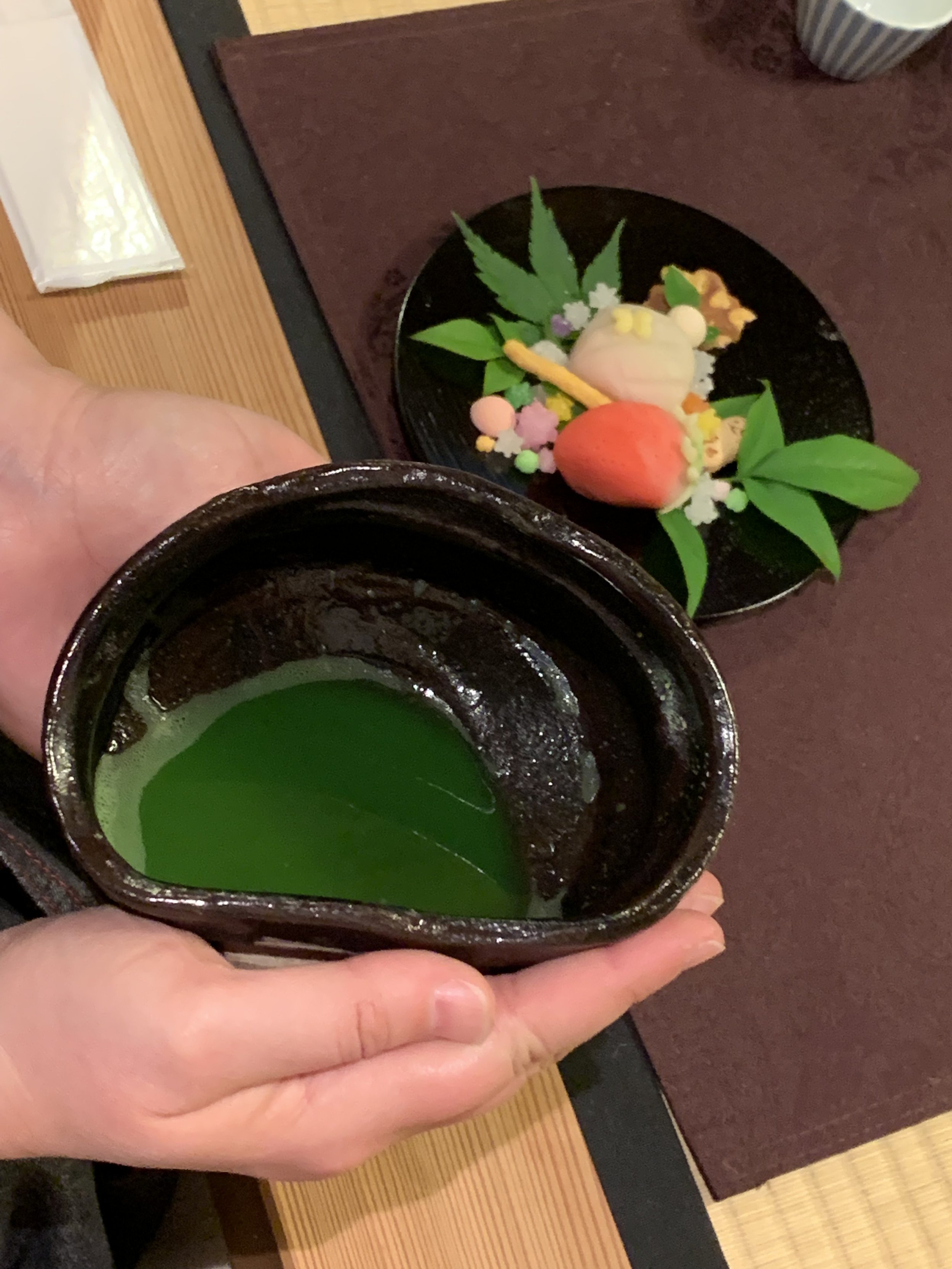
Introduction to Wabi-Sabi and the potential it holds for corporate improvement
| Principle | Lesson | Corporate application |
|---|---|---|
| Essence over excess | Appreciate what is already there and remove the unnecessary | Simplify products, processes, and communication |
| Imperfectibility | Value the irregular and the impermanency | Find improvement and productivity in experimentation and feedback |
| Time and change | Find beauty in use and age | Design for lasting adaptation |
| Human touch | Respect mistakes, skills, and material knowledge | Preserve human judgment and expertise |
From tea and Japanese traditional crafts to modern life
Wabi-sabi became influential in Japan through the application and exploration of Buddhist principles within the tradition of tea and handmade utensils. For example, the irregularities of a tea bowl expresses its beauty and uniqueness because it is inherent to the material, hands, and moment in which it was made. In this context, perfection is not about standardization, but about simplicity, naturalness, and the soul of the maker.
Japanese crafts showcase this way of perceiving and the appreciation of reality becomes tangible.
In pottery, a fingerprint or an uneven surface carry the maker’s imprint. In metalwork, tools marks and patterns can remain visible as evidence of the process. Indigo dyed textiles are meant to change with light, washing, and use, developing each time a new way to appreciate the same object. The process of indigo dying (Aizome) is in itself a practice of continuous improvement as it requires to constantly make sure that the conditions remain optimal for its development.
This does not mean that every mistake is automatically beautiful and that everything is relative. Wabi-sabi demands an effort to pay attention and learn from the difference between a meaningful trace left by human making and a failure that should be corrected to be improved. Kinstugi is another practice that demonstrates that a mistake or accident can turn into something more sustainable and appreciable if there is an effort put into making it possible. Kinstugi is a practice that repairs daily life objects with precious gold. Learn more about Kinstugi on TokudAw’s Instagram
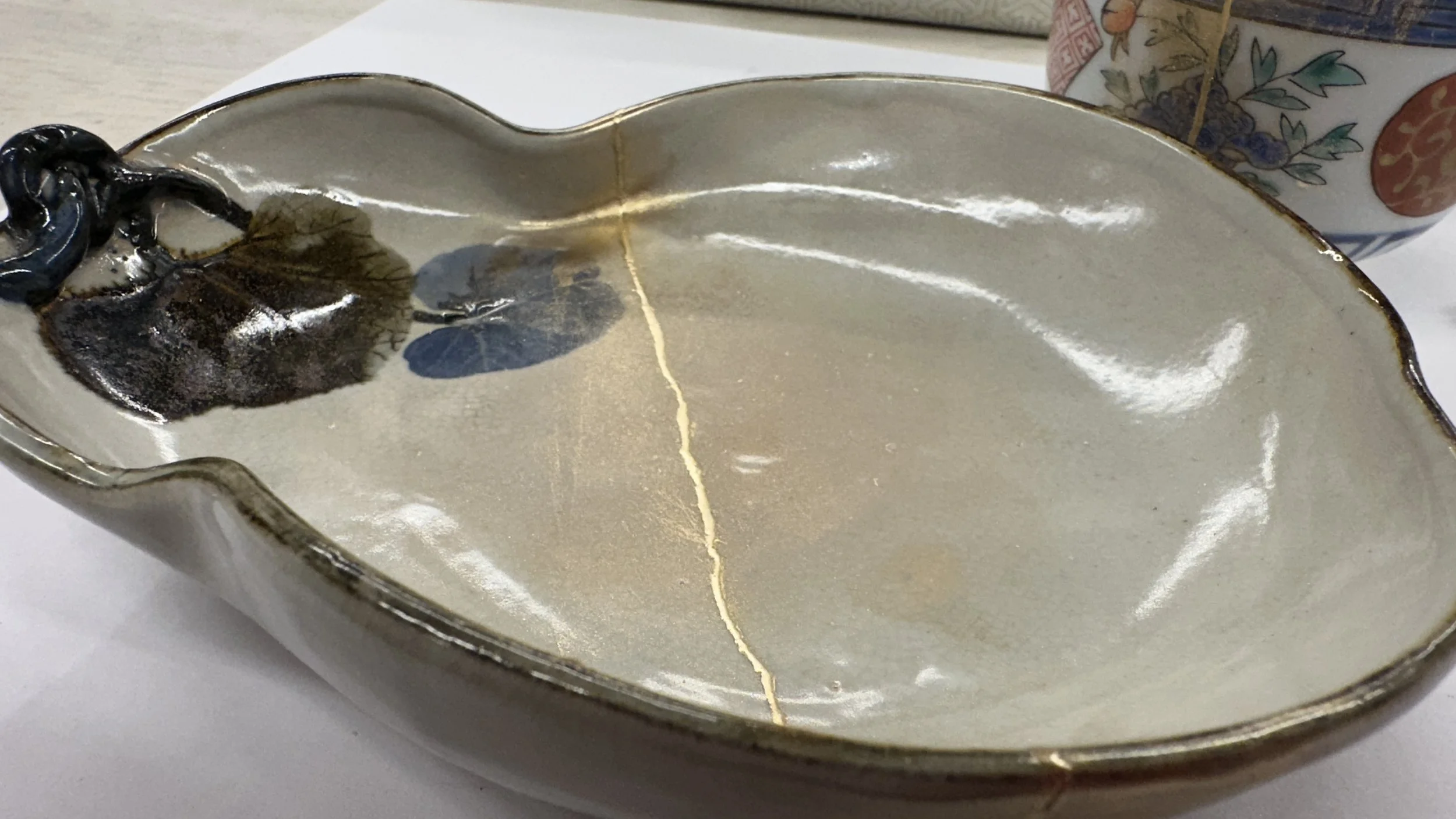
Pottery: Irregularity are signs of uniqueness
Metalwork: Marks are traces of process and effort
Textiles: Fading and unpredictability become part of improvement
Kintsugi: Damage can be acknowledged and incorporated rather than ignored and forgotten
Automatization and Human expertise: A sustainable combination
One aspect that makes an object special is that it does not look like any other. Machines can reproduce what humans do, or even do it “perfectly”. However, when everything looks and tastes the same, it becomes less interesting to experience. When observing some traditional crafts in Japan, it can make you think where to find the balance between the use of technologies such as AI, and the importance of the human touch, as imperfect as it can be.
Japanese Lacquerware and Kimono production show the value of specialised human knowledge. A lacquerware piece may involve a variety of people and their specific gesture: preparing the base, applying the layers, polishing the surfaces, and designing and creating the ornaments. Kimono production connects silk producers, spinners, weavers, dyers, designers, and painters. Each person participates in the process, while the final quality depends on how all the stages are bound to one another.
Longevity can also be a product of intentional imperfection. At Nikko Tosho-gu, the Yomeimon Gate contains a deliberately inverted pillar that carries the name of “sakabashira”. The carved pattern is upside down so that the gate can never be considered complete. Over time, this has been a way to avoid misfortune and express the idea that what reaches absolute perfection has only room for decline. If you observe you may be able to spot the tiny imperfect details in other traditional objects and construction in Japan.
From philosophy to corporate practice
Wabi-sabi is a practice that reinforces the perception of imperfection and incompleteness not as failures but as a source of information, and potential for improvement. Applying wabi-sabi to corporate structures, means to explore ways to replace the pursuit of perfect systems with continuous observation, refinement, and adaptation. Organization can simplify what is unnecessary, learn from mistakes, and preserve valuable human expertise while adjusting workflows that can evolve over time.
A company does not embrace wabi-sabi by doing handmade only. The philosophy becomes valuable when it influences how people approach mistakes, complexity, expertise, and awareness of change. Wabi-sabi does not mean to lower standards but rather demands to understand how excellence and improvement can emerge through care, repairs, and time. It offers a constant alternative to the pressure for everything to look similar, measurable, and complete, especially important to understand and learn from in this time of rapidly scaling AI implementations and prevalence of AI slop executions.
Learning Wabi-Sabi through TokudAw’s Treasure Sessions
TokudAw’s treasure session can help you meet practitioners, observe the detailed processes, and experience them. Find out more about sessions like Kintsugi, Ikebana and many more. The aim of the Treasure Sessions is to combine cultural discovery and facilitated workshops that connect to your organization’s requirements, business goals or team building needs for STEAM organizations. Participants do not only learn wabi-sabi as a theory but have hands-on experience on lessons that can be applied further in your own organization. As our sessions are often craft-based, participants will usually create a memento to take back to the office as well. If you want to know more about these unique experiences and the variety of Treasure Session TokudAw has to offer, contact us.
FAQ
Does Wabi-Sabi only apply to design and objects?
No. Wabi-sabi is a continuous practice of a mindset that distinguishes continuous improvement and avoidable failure, while valuing care and cherishing the incomplete state.
How can wabi-sabi help with innovation?
Wabi-sabi reinforces the idea of testing, learning from mistakes, removing the unnecessary, and improving existing systems, instead of always aiming for perfect final solutions.
Why is Japanese craft and philosophy relevant in the age of AI?
Wabi-sabi highlights human abilities and transmitted knowledge that cannot be standardized or lose value if looking too perfect. These qualities must complement technology and help organizations to decide and find the balance between what should be automated and what should preserve the human touch.
What are good team building activities that integrate Japanese culture?
Treasure sessions are designed for just that! integrating a bit of culture and a bit of science and psychology tailored to each organization's needs.
Don't forget to contact us to learn more about the treasure sessions.
